


By the Fall of 1979 I had possibly run through one career already, or at least the beginning of one: I'm not sure. From '75 to '78 - still a teenager - I did some illustration work for TSR's magazine The Dragon and for a couple of companies that published either supplements for, or alternatives to, TSR's Dungeons and Dragons rule books.

Samhain, ink and watercolor, 1982
The experience hadn't been a pleasant one. So went back to school to concentrate on doing better work, and a different kind of work. I was still making fantasy art and that art was still based on mythology and folklore. But it - and I - had a different center than we'd had before, a center closer to the roots of that material.
I'd been awarded a Fellowship by an arts foundation and was about a week away from a trip to Europe when I found a copy of George Bain's Celtic Art: the Methods of Construction. I'd seen knotwork before - mainly in art history books - but I'd never seen a book that explained how I might make those patterns myself. I bought the book immediately and then packed it away, since I was about to head off on my European trip. It was five or six months before I dug the book out and went to work with it.

So first with traditional border patterns, and then with original ones, I spent a large part of the 80's doing knotwork: borders on drawings and paintings, decorations on musical instruments, on covers and illustrations for small presses, LPs, cassettes, and then CDs; in my mural for the Thousand Oaks Public Library in California; on leather and wood; and, I guess, on anything that would sit still long enough.
Even when I made the transition to working digitally in 1988 I used knotwork borders; I animated a couple of them. I found uses for knotwork in several game projects and even now, long afterwards, I return to my knots from time to time.
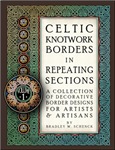
In 2007 I collected some of my original celtic knotwork borders into a book, where each border's shown in multiple sizes and (often) in circles as well as sub-divided rectangles.
So that's my story; I'm sticking to it. Here at The Celtic Art Works I've gathered together just about all of the Celtic artwork I have in print, in books and on one kind of merchandise or another.
I hope you enjoy your visit!
August, 2011

1 As you follow a band within the pattern, it must pass alternately over and under in the same way that a simple basket (or tabby) weave does. When a band passes over another band in the pattern, it must pass under the next band it crosses.
2 There should be no loose ends in the pattern: every part of the pattern should form a single, continuous loop.
3 In addition, most of us believe that in its ideal form a knotwork pattern should be composed of only one band, with no other bands or rings in the design.

Where do these rules come from? Well, we sort of made them up. But not really.
When this style of decoration emerged and found its home in illuminated manuscripts, on standing stones, in jewelry designs, and elsewhere, no one was writing about what they were doing. Writing itself, especially in book form, was quite rare - and books themselves were unbelievably expensive to produce (all by hand, of course).
So if we want to understand what these medieval artists were trying to do we have to look at what they did, and then think about what we're looking at.
The three rules I wrote above are our best guess about what was important to these artists. You shouldn't assume that every historical knotwork pattern adheres to the rules; many break them. We believe that they're rules because on the whole, this seems to be the ideal the artists were trying for.
Now... did they ever break the rules on purpose? In forms of knotwork that show animals or plants we sometimes see loose ends in the designs - in places like the ends of tails, or claws, or wings, for example. There are cases where those loose ends turn into abstract bands of patternwork; but there are also cases where the ends seem to have been left there deliberately, to clarify the shape of the animal or plant.
We may see similar broken rules in the over-and-under weave of the pattern in these pictures of animals. Sometimes this seems to be the result of those loose ends of tails, wings, or other shapes. Leaving those ends loose just makes it impossible to resolve the alternating over-and-under pattern without errors.
And there are even many cases in which abstract border designs break the rules, especially the third one - that is, they may be made up of more than one band, and sometimes even include pretty obvious "rings" within the design.

Today we believe that these three rules matter, and we think they mattered in medieval times as well. Now, Celtic knotwork has been revived and reinterpreted before and it doesn't always work just the same way in every generation - if you look at the Celtic Revival work from the early part of the twentieth century you'll be more likely to find some broken "rules", and also a unique tendency to make internal splits, like holes, in bands that may still respect the rules. (Other parts of the pattern obey the over-and-under rule as they weave through these holes.)
Those Celtic Revival artists are a part (quite a large part) of the influences on my own work. That's partly because it was their work, and their books about that work, that taught me to make this kind of art back in the early 1980s.
I get a lot of questions about the meaning of this or that design - or requests for "the Celtic symbol for..." - but that's simply not what the designs are for, or ever have been for. It's just what we want them to be.

We monkeys want to assign meanings to things: we're built that way. It's got nothing to do with whether those meanings were there already. These patterns in their historical form were not symbols, and didn't represent specific ideas; and anybody who tells you differently is probably trying to sell you something.
Okay, I'm trying to sell you something, too: but I'm just trying to sell you a T-shirt. I'm not trying to sell you a belief.
Odds are, you may not believe that these patterns are abstract images and don't represent ideas like "loyalty", "peace" or, for all I know, "the ineffable excellence of wombats". Because, like I said, we want to find meanings. And I don't suppose it does a lot of harm if you get a tattoo that (you think) is praising the wombat. So, you know, go for it.
I've played with this misconception by creating knotwork versions of actual, modern symbols like the peace sign, the biohazard symbol, and the skull and crossbones. My earliest T-shirt designs for Saga Shirts are good examples of that subtle bit of irony.
Your mileage may vary. So like somebody told me once.... "Whatever blows your skirts up".
What we call Celtic knotwork design isn't uniquely Celtic; at one time or another similar motifs have emerged across the globe, from China to Africa. It's probably not even originally Celtic.

The Celts, who never even called themselves by that name, loved bright colors, curved shapes, wine, and mayhem. They didn't write anything down. Like a lot of tribal peoples, they believed that writing was a magical act that you shouldn't undertake casually.
That's because by setting the name of a thing down as an object you have created something that has power over the thing it represents. Think voodoo dolls: you're on the right track. When trade made it necessary, they jotted their notes in Greek, and it was the Greeks who called them the Keltoi - later on, the Romans slurred that into Gauls.

The early Celts picked up design influences from those Greeks and from the Scythians, and learned some new tricks as they spread west across Europe, over the English Channel, and beyond the Irish Sea. You can see a lot of Scythia in that beautiful early Celtic design - sweeping arcs, stylized animals, golden granules and fine lines.
Ancient Celtic art, especially in the La Tene style, is all about curves and color. It's gorgeous stuff that doesn't have a thing to do with what we call knotwork.
Knotwork (or interlace) design is a lot more like ancient Saxon and Scandinavian art, which is full of twisting gripping beasts and interwoven lines. That was a very different and also a beautiful form of design, organic and strange, but rarely organized.
By the sixth century the Celts had become pretty well settled in the island of Britain. They were the Britons, after all. The Romans came, and made a lot of roads, and whipped a lot of people, and then left. The Britons might have had a chance to figure out who they were again, but that's right about when the Saxons showed up.
In most cases when one group of people conquers another one they turn the old people into peasants or slaves and get on with it. You can tell a lot about how this works by looking at the place names in a country. Think about all the Native American names for towns, rivers, and mountains that we see in North America. The conquerors ask the natives, "What do you call this?" It's like that.

When the Saxons poured out across Britain, though, it was another thing entirely. In all of what's now England - south of Scotland, east of Wales - you almost never find a Celtic place name. That's because, when the Saxons looked across the field, there weren't any Britons left for them to ask, "What do you call that river?" So they had to make up their own names for everything.
The Saxon conquest was so catastrophic that in later years, Welsh Christians refused to try to convert the Saxons - it was bad enough, they figured, that they had to share this world with them.
The Britons who were left alive ended up in Wales, in lowland Scotland, and across the Channel in Brittany. During the seventh century the Saxons tried to continue their conquests in the North. Up there they found a mixed bag of Picts - who'd been in Britain longer than the Britons - the remaining Britons, raiders from over in Ireland, and Scandinavians. The Saxons came up from the south and the fact is that no one knows exactly what came next.
For an entire generation, all written records just... stopped. And at the end of that time things had settled down. The Picts and Britons and the Gaels from Ireland had become more or less one people, who turned out to be the Scots. The Saxons and the Scandinavians had become more or less one people, who turned out to be the English. Right along the Scottish border things were a bit more mixed up. But they weren't all killing each other any more.
And something wonderful finally happened.

When you get that many different kinds of people mixing together you see a lot of traditions mingling and brewing up something new. So at the end of this truly awful period of history we see the Germanic and Pictish and Celtic traditions combining, and all of a sudden there's new music, new art, and new poetry. The three-sided frame harp came out of this mess. And so did what we call Celtic knotwork.
That's why, way up above the history, I said that it's not uniquely, or even originally, Celtic. This is a style of art that came out of the violent collision of several different cultures. Once they had it, it appeared on everything they made, from stone monuments to jewelry and metalwork to some of the most beautiful books - handmade, illuminated manuscripts - that anyone has ever made.
In more recent years Celtic Art has cross-pollinated other art forms, like in the Celtic Revival, where it was changed and informed by the Arts and Crafts and Art Nouveau styles. I'd place my own work in, I guess, a post-Revival mode - since that Celtic Revival work has certainly influenced mine.

Merne, John G. - A Handbook of Celtic Ornament
Crawford, H.S. - Irish Carved Ornament
Henry, Francoise - The Book of Kells
Stead, I. M. - Celtic Art in Britain Before the Roman Conquest
Larmour, Paul - Celtic Ornament (a small collection of Celtic Revival art)
Leeds, E. T. - Early Anglo-Saxon Art and Archaeology
Chadwick, Nora - Celtic Britain
Cunliffe, Barry - The Ancient Celts

Cunliffe, Barry - Iron Age Communities in Britain

Markale, J. - Celtic Civilization
Powell, T.G.E. - The Celts (Ancient Peoples and Places)

Ford, Patrick (tr) - The Mabinogi and Other Medieval Welsh Tales

Kinsella, Thomas (tr) - The Tain
Gantz, Jeffrey (tr) - Early Irish Myths and Sagas

Jackson, Kenneth Hurlstone (tr) - A Celtic Miscellany

Want to send your site's visitors here to see the Celtic Art and merchandise? That's easy.
Just browse my collection of banners on the banners page.
